Dooars in the monsoon: tea gardens, rivers and homestays
By Torsa Trails · Updated 11 October 2026
From mid-June the national parks shut their gates, and most people cross the Dooars off their list until autumn. That's a mistake if what you want is green, quiet and slow. The rain turns the tea gardens a colour you won't see in winter, the rivers come alive, and you have the homestays almost to yourself. Here's what stays open, what doesn't, and how to plan around the weather.
- National parks and wildlife sanctuaries close every monsoon, usually 16 June to 15 September.
- Tea gardens, rivers, hill villages and homestays stay open.
- Pick one or two bases and stay put, instead of moving every day.
- Keep a spare half-day in the plan for weather and roads.
What closes, and why
Every year the West Bengal forest department closes the national parks and protected forests of the Dooars for the monsoon. That includes Gorumara, Jaldapara and Chapramari. It's the breeding season for much of the wildlife, and the forest tracks turn to mud anyway. The dates are announced each year and usually run from 16 June to 15 September. So no jeep safaris, no watchtowers and no elephant rides in these months.
If wildlife is the reason you're coming, wait for the parks to reopen. Our guide to when to visit Gorumara and Jaldapara covers the open season month by month.
The tea gardens are at their best
The Dooars are low-lying, warm and wet, and the tea here grows fast through the rains. Most estates make CTC tea, the strong, granular kind that ends up in everyday chai, and plucking carries on right through the monsoon. The season only ends in December, when the Tea Board sets the last plucking date for Dooars and Terai factories.
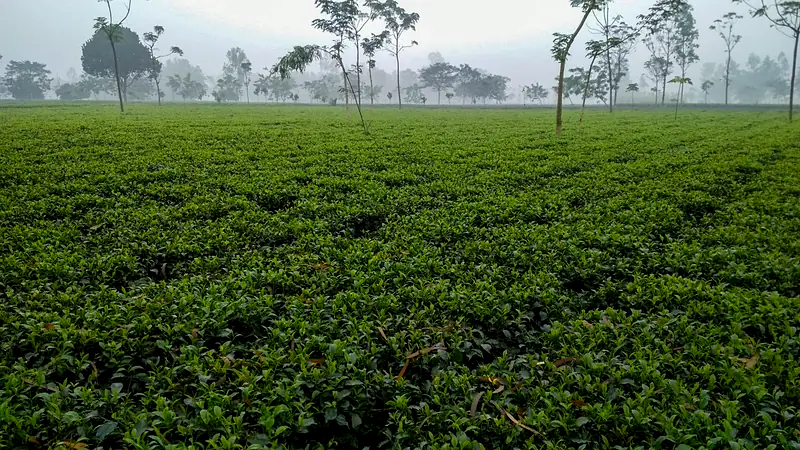
For a visitor, that means rows of bright green bushes under tall shade trees, pluckers out in the morning, and mist sitting low over the gardens after a night of rain. The drive from Sevoke through Malbazar and Chalsa runs past garden after garden, and in July and August it's about as green as Bengal gets.
Most tea estates are working farms, and walking inside one needs the estate's permission.
The rivers wake up
The Dooars are river country. The Teesta, Jaldhaka, Murti and Torsa all come down from the hills and spread out across the plains, and in the monsoon they run full, brown and loud. A few places worth a stop on a dry spell:
- Rocky Island on the Murti, near Samsing, where the river breaks over boulders.
- The Suntalekhola hanging bridge, just past Samsing.
- Bindu, the last village before the Bhutan border, where the Jaldhaka comes through a dam.
- The Samsing tea slopes, where the gardens start climbing into the hills.
Watch the rivers from the bank, not the bed. Water can rise fast after heavy rain upstream, even when it isn't raining where you are. Our drivers know which stretches are safe to stop at, and we'll skip a stop if the river says no.
Homestays in the rain
The monsoon is homestay season. Rooms that are hard to book in October are usually easier to find in July. There's rain on the tin roof at night, tea on the verandah while the clouds come down the hill, and a kitchen that cooks for a handful of guests, not a coach party. If you want to switch off for a few days, this is when to do it.
Stays are matched to your budget and confirmed in writing before you pay. If a stay is full, we offer one of a similar standard.
Roads and rain
The plains of the Dooars are easier going in the rain than the hills. The road that worries everyone is NH10 along the Teesta between Sevoke and the hills, which has been hit by landslides again and again. In July 2025 the swollen Teesta flooded stretches of it, and traffic to Kalimpong was diverted up the longer road through Gorubathan and Lava.
That's why we plan monsoon trips with a spare half-day and an alternative route. We check road conditions every morning, and our drivers decide whether a road is safe to drive.
How to plan a monsoon trip
- Stay put. Two bases for two nights each beat four hotels in four days.
- Keep the plains in the plan. Tea gardens and riverside stays are the heart of a monsoon trip.
- Go light on the hills. One hill village is plenty. Lava, Rishyap and Lolegaon are known for landslides from July to September.
- Pack for wet. A proper rain jacket, quick-dry clothes, sandals or shoes with grip, and long socks for wet grass and forest edges, where leeches are common.
- Expect slow. Rain stops play sometimes. That's part of it.
A short trip that works in the rain
If you want one easy plan for the monsoon, ask for the short 2-night version of our Dooars Jungle and Tea trip. It skips the closed parks and stays on the Jaldhaka: two nights in Jhalong or Bindu with the Bhutan hills across the water, a morning at the Bindu border village, and the Samsing tea slopes and Rocky Island on the way back.
We're based in Chalsa, right in the middle of the tea belt, so we see these roads and rivers through the whole monsoon and plan around what they're doing that week.
Who it's for
The monsoon Dooars are for people who want green, quiet and time to sit. They're not for a wildlife holiday, and not for anyone who needs every hour planned. If that sounds like you, it's one of the best-kept parts of the year here, and the easiest time to get the stays you want.
Planning a monsoon trip?
Tell us your dates and what you'd like to feel. We'll build a plan around tea gardens, rivers and homestays, with room for the weather, and send it within 1 to 2 hours.