When to visit Gorumara and Jaldapara
By Torsa Trails · Updated 11 October 2026
Gorumara and Jaldapara are the two national parks most people mean when they say "the Dooars". Both sit in the forested plains below the Bhutan hills in North Bengal, and both shut their gates for part of every year. Pick the right month and you get open forest, cool mornings and a real chance of a one-horned rhino. Pick the wrong one and you find a locked gate.
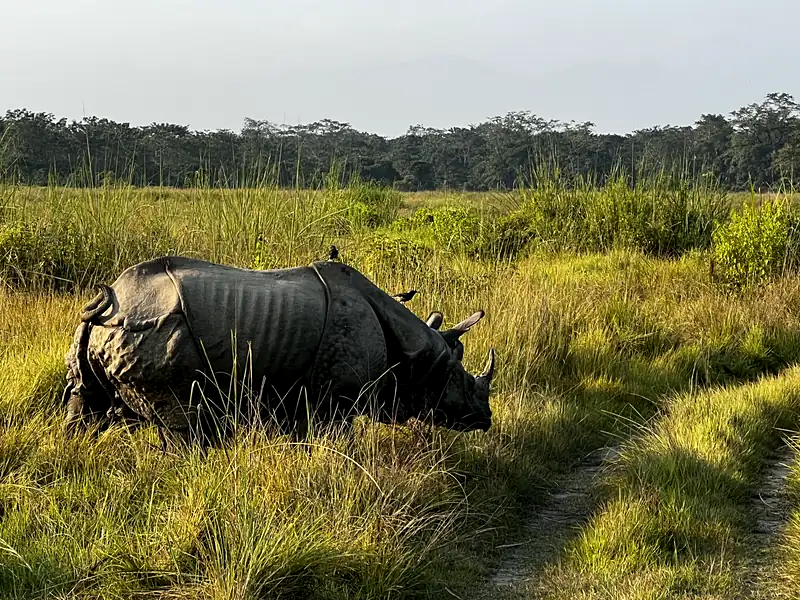
- Go between October and May.
- Both parks close every monsoon. The forest department sets the dates each year, usually 16 June to 15 September.
- For rhinos, Jaldapara is the better bet. For watchtowers and river views, Gorumara.
- Three nights is enough to see both without rushing.
Two parks, two moods
Gorumara is the smaller of the two, with the Murti and Jaldhaka rivers running along its edges. Lataguri, the small town most visitors stay in, sits right at the forest line. A Gorumara visit is mostly about watchtowers: you ride a jeep into the forest, climb a tower above a clearing or a salt lick, and wait quietly for animals to come out.
Jaldapara lies further east, near Madarihat, on the banks of the Torsa river. It's a park of tall grassland and riverine forest, and it's known for the Indian one-horned rhino. Here the safari itself is the main event, by jeep and, when it runs, on elephant back.
Month by month
Mid-September to November: the gates open again
The parks reopen after the monsoon break, usually from 16 September. The forest is at its greenest and the air is washed clean. This is also festival season in Bengal, with Durga Puja and the long weekends around it, so stays and safari slots fill fast. If your dates fall around the Puja holidays, plan early.
December to February: cold mornings, quiet roads
Winter is the most comfortable time to be in an open jeep at dawn, as long as you dress for it. Mornings in the Dooars can be foggy and properly cold, so carry a warm layer, a cap and gloves for the first safari of the day. Christmas and New Year are busy weeks. January and February are calmer.
March to May: warm days, long light
As the season warms up, afternoons get hot and the forest gets drier and more open. Some local guides prefer the late-afternoon slot in these months, when animals move again after the heat of the day. School holidays in May bring families, so book ahead if you're travelling then.
Mid-June to mid-September: closed
National parks close every monsoon, usually mid-June to mid-September, on dates set by the forest department. This is the breeding season, and it's also when rivers rise and forest tracks turn to mud. The rest of the Dooars stays open, and is beautiful in the rain. See our guide to the Dooars in the monsoon.
How a Gorumara safari works
Jeep safaris and watchtower visits run in fixed shifts through the day, from early morning to late afternoon. Permits are issued by the forest department, and jeep trips start from Lataguri. Each jeep takes up to six people. The shift times change with the season, so confirm them for your dates. Gorumara and Jaldapara both close on Thursdays.
The watchtowers people ask about most:
- Jatraprasad. The one most visitors want. The trip usually takes in Rhino Point nearby as well.
- Medla. On the eastern side, reached partly by bullock cart, which is half the fun.
- Chandrachur, also called Khunia. It overlooks a salt lick that draws animals in.
- Chukchuki. The pick for birdwatchers.
How a Jaldapara safari works
The main entry is at Madarihat, where the forest department's Nature Interpretation Centre handles permits and safari bookings. Every traveller needs an original photo ID, and you'll be asked for it on the day. Jeep safaris run in the morning and the afternoon.
Elephant rides start from near Hollong, deep inside the park, early in the morning, with up to four people on each elephant. They are very limited and can't be guaranteed. We'll try, and plan a jeep safari as the backup. Elephant safaris run in very small daily numbers and are booked online when the forest department opens them. Jeep safaris are often booked the day before or on the day, and the rules can change from season to season.
One park or both?
If you have three nights, do both. Spend two nights around Murti or Lataguri for Gorumara and a day up the Jaldhaka valley to Jhalong and Bindu. Then drive east through the tea gardens to Jaldapara for one night and a dawn safari. That's exactly how our Dooars Jungle and Tea trip runs. With only a weekend, pick one: Jaldapara for rhinos, Gorumara for watchtowers and the river.
The drive east from the Murti to Jaldapara takes about 2 hours through the tea estates.
What to wear and carry
- Muted colours: greens, browns, greys. Skip white and bright red.
- A warm layer for early safaris from December to February.
- An original photo ID for every traveller, plus a phone copy.
- Binoculars if you have them, and a zoom lens if you shoot.
- Patience. Keep your voice down, stay in the vehicle, and never feed an animal.
What we can and can't promise
Safari slots, park entry and watchtower visits are decided by the forest department, often on the day. Subject to availability. We help you book where possible, or you can book directly. Tickets are paid at actuals unless your plan says otherwise. And no one can promise a rhino. What we can promise is a driver who knows the roads, timings planned around the shifts, and pickup from wherever you are.
Want to see both parks in one trip?
Our Dooars Jungle and Tea trip covers Gorumara, the Jaldhaka valley and Jaldapara in three nights. Tell us your dates and we'll send the day-wise plan and cost within 1 to 2 hours.